
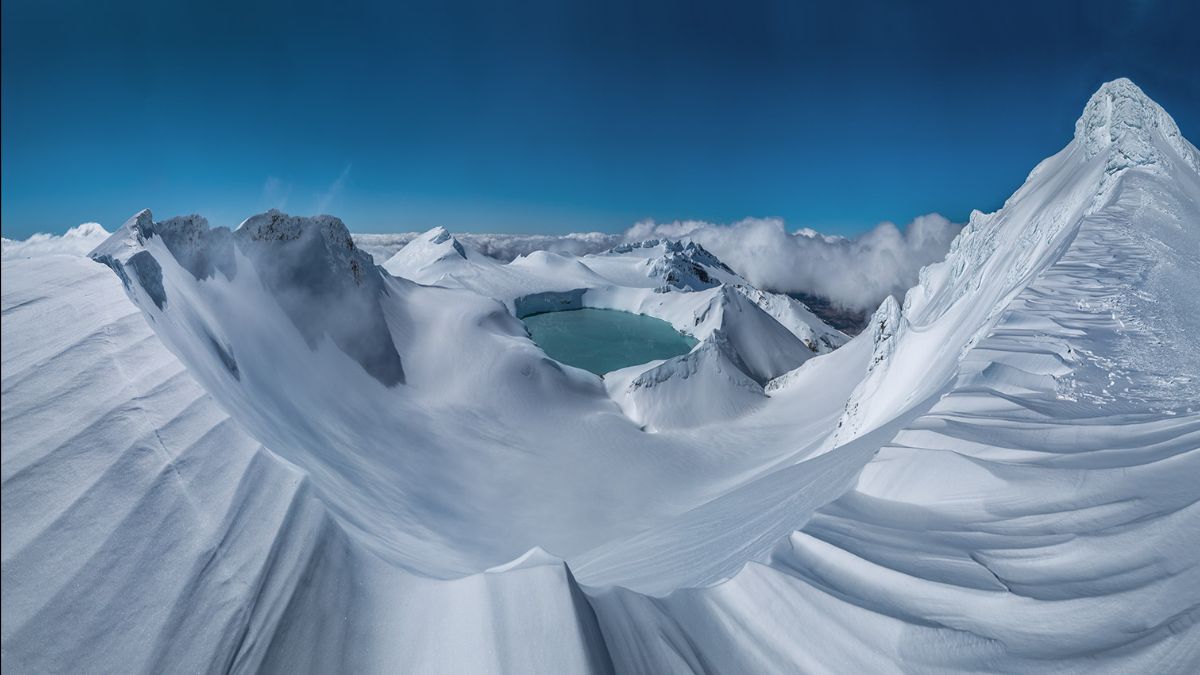
A spring climb of Ringatoto and the east ridge of Tahurangi.
Perched on the edge of a sheer cliff at 2,080 metres, Whangaehu Hut serves as the highest refuge on New Zealand’s North Island. The NZAC refurbished this four-bunk shelter in 2017, offering sturdy protection against hostile alpine conditions. Below the hut, Whangaehu River cuts through volcanic rock – the same path taken by lahars and Crater Lake overflow. The most tragic overflow occurred during the Tangiwai Disaster in December 1953, when a lahar destroyed the rail bridge just as a Wellington to Auckland express crossed it, killing 151 of 285 passengers aboard.

The Whangaehu gorge presents a dramatic landscape. Depending on season and weather, it transforms into a sinister chasm filled with swirling mist, tortured lava formations, loose rock fields, and gushing water. Winter snow softens the Mordor-like terrain, yet the yawning hole demands respect.
The hut’s eastern outlook extends toward the Desert Road and Kaimanawa Ranges. Dawn becomes magical as the rising sun illuminates the mountain walls surrounding three sides with alpenglow.
Peter Laurenson and Simon Williamson – “The Whippet,” known for his “relentless high-speed traversing of hill terrain” – arrived Thursday afternoon from Tukino Village. A two-day weather window lay ahead.

As they climbed toward marker poles on the ridge above the hut, Laurenson noted: “Ah, the points are biting in nicely.” Williamson replied: “Yeah, nice to have crampons on again eh.” Winter disruptions and COVID restrictions had prevented them from using crampons until this moment.
On the ridge top, they assessed their objective – the northeast face of Ringatoto. From their vantage point, the face appeared steep, with rock cliffs at the base attracting concern. Hard frozen conditions suggested the face would be equally challenging. After discussion, they agreed to explore an alternative: “Let’s go right rather than left at the bottom of the gorge then, and see what we find,” Simon suggested.
They settled into the otherwise empty hut for a pleasant evening. Sunset was nice; dawn brought mauve alpenglow followed by a slightly breezy bluebird morning.


As they traversed a steep section west of the hut, clearing the sheer cliff and accessing the river valley, hard frozen snow confirmed they had made the right choice. Crunching up the gorge brought joy. “First time in here for me,” Laurenson remarked. Simon reflected: “Yeah, interesting to see the terrain from down here. Somewhere up there the accident happened.” A fatal NZAC climbing accident had occurred just over a year prior beneath the ridge leading to Cathedral Rocks. Simon, then Wellington Section President, had been closely involved in the aftermath.
As the slope steepened near a gushing waterfall, the Whippet posed beside it for photographs. Soon their intended route appeared – steep snow slopes beginning at approximately 2,100 metres.

Laurenson led off, quickly realising the straightforward terrain featured hard surface conditions with increasing exposure risk higher up. “I’ll put in an anchor and we can get in some pitching practise Simon,” he decided.

Five pitches later, they had reached nearly 2,350 metres, where softened snow made further pitching unnecessary. The Whippet was not his usual self, pushing up the slope. Laurenson plugged steps, planning to wait near the north ridge summit.
“Hmm, where the hell’s he gone?” Laurenson wondered. Rather than following Laurenson’s footsteps, Simon had chosen to go left around a rocky buttress – a route that appeared “very steep and exposed” from Laurenson’s vantage point. After anxious minutes, “the Whippet’s helmet broke the ridgeline and he plodded slowly up.” Simon commented: “A bit steep on that side. If there was to be a place to get out the rope I reckon that was it.”

At 2,591 metres atop Ringatoto, a stiff breeze drove them behind a hunched outcrop of rime ice for lunch. Simon explained: “I’m feeling a bit dodgy for some reason, no power in my legs.” Food seemed to perk him up, reviving the inner Whippet as they prepared for the base of the east ridge of Tahurangi.

On the ridge, the entire summit plateau abruptly came into view. Laurenson’s camera shutter finger was kept busy as they proceeded upward. They cleared the rime cliff section without problems, but larger ice cliffs forced them across to snow slopes beneath them.


Soon they reached Tahurangi’s top. “Of the six times I’ve reached Tahurangi over the years, this was in the best conditions yet. Fluted snow made a beautiful foreground for the best view in the North Island.”

“Well mate, at least it’s all downhill from here,” Laurenson reassured Simon. They had been moving for approximately seven hours – they needed to descend onto the plateau, skirt Crater Lake, and descend Whangaehu glacier.
Laurenson led off back down Skyline Ridge. He expected leisurely snow trudging once off the ridge. Instead, hard frozen snow returned “with a vengeance.” They could only “face in and front point horizontally for what seemed the longest 200 metres” he could recall. Drenched and with burning calves, Laurenson gratefully reached the saddle.
Their remaining concern was avalanche danger on the north-facing slope. They decided to descend, taking separate lines. About one-third down, Laurenson resorted to a bum slide that triggered a small, controllable avalanche. Simon followed, “riding his own small but enlarging pile of bum slide debris.”

As light angles dropped, photographic conditions improved as they navigated around Crater Lake toward Whangaehu glacier’s head, where they viewed their morning climbing route. “Wow, it looks like a real climb from here,” Simon enthused.

The glacier descent proved easy as the sun had softened conditions nicely. Laurenson moved slowly, soaking up the tranquil ambience. As they neared the hut, the tiny box perched above the sheer cliff was particularly memorable.
Remarkably, they found no weekend warriors at the hut – it was theirs for a second night. Next morning dawned crystal clear and still. Though tempted by the fine weather, they packed up feeling well satisfied with their previous day’s ten or more hours of movement.
Halfway up the slope above the hut on departure, Laurenson suddenly tensed. “We’re on no slip terrain Simon.” Their crampons barely bit into the ground. Directly beneath them was a cliff. Simon agreed: “I reckon. No place for complacency for sure.”

Peter Laurenson – www.occasionalclimber.co.nz