
Met Service had granted my wish – a two day weather window and an avalanche risk deemed green – low. Having been rebuffed twice before by Mount Cupola (the second time, just a few weeks earlier) due to bad weather and snow conditions, I was now a man on a mission.
An early flight from Wellington to Nelson, rental vehicle pickup, quick stop for camping gas, drive to Saint Arnaud, ride with Hamish in his water taxi to Cold Water Hut, five and half hours march and I was at Cupola Hut, arriving in light snowfall at 4.30pm. The forecast had indicated the snow, so I wasn’t concerned.
I’d come alone, thinking that crampons and two axes should be ample for a grade 1 climb in clear conditions. At the hut though, three others were already settled in and had the stove pumping out plenty of warmth. Grant, Rob and Martin, all from Nelson, shared a similar plan to mine.
Overnight, light snow continued to fall until about 3am, when the sky began to clear. Although we were still loosely parties of one and three, we’d all agreed that there was ample daylight, so no need for a very early alpine start. I was first away, heading up above the tree line, a minute’s walk above the hut, at 6am.
With eight bunks, Cupola is an ex-conservation research hut exuding high-country charm. It’s situated just in the beech forest below an expansive tussock shelf, with an unimpeded view directly north to the intimidating south face couloir route on Mount Hopeless. Now breathing in fresh mountain air up on the shelf, I was glad that Cupola’s north face couloir looked more inviting. The conditions looked really good – a clearing sky, minimal breeze and a dusting of fresh snow, though not enough to pose any serious avalanche threat.

As I climbed up the shelf, the rising sun began to show its presence. If you’re a photographer, you’ll know that alpenglow is impossible to resist, so my progress was sporadic. The three Nelsonites soon appeared ant-like below me, adding another dimension to my photographs. The powder dry snow deepened as I climbed, so plugging up became hard work. After a while the others caught me and from then on we all shared the lead, making things quite a bit easier for me than if I’d been alone.
From above the hut in the crystal-clear air, the base of the north face couloir, about 550 metres higher, had looked to me about an hour away. It actually took a good two hours. As we neared the narrowing neck of the couloir it looked quite steep – perhaps 50 degrees at the steepest point, but the snow under foot had firmed up nicely, suggesting a pleasant, straight-forward climb.
Soon after I’d climbed in to the narrow neck though, the frozen snow had morphed into hard ice with a thin dusting of dry powder. Getting my axes in to the hard surface now demanded a good swing with each placement. And I found myself wishing that my feet were not in tramping boots, part of my fast and light plan, but rather in my heavier semi rigid Karakorams.

For the next hour we battled our way upwards. Rob, the youngest of us, took the lead, breaking up the surface a little for those following as he forged ahead. Even so, there was no place to relax in the couloir and full concentration on maintaining three effective points of contact was essential until we reached a snow field, angling up to the left.
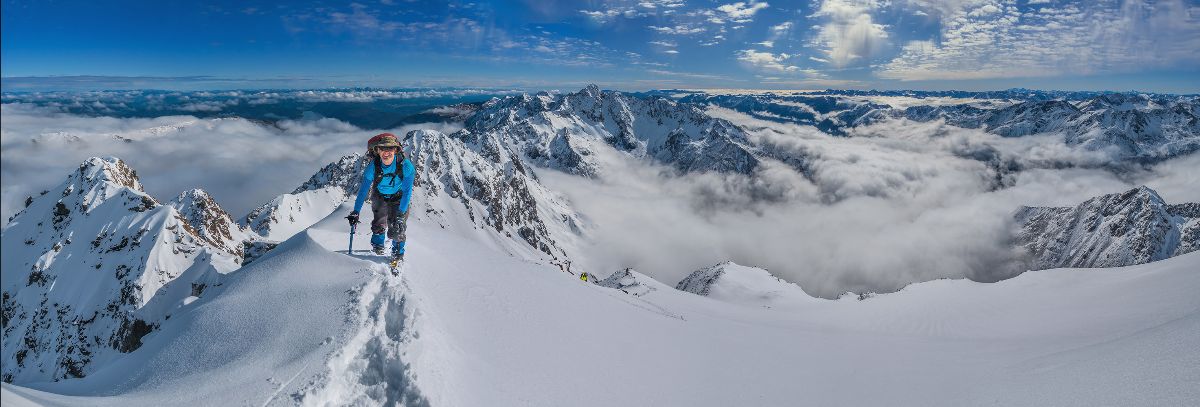
While the notion that we still had to down-climb the icy couloir played on my mind a bit, it was also fascinating to see what unfolded above the couloir, because this section of the climb is hidden from below. The snow field led to a broken rocky ridge. In turn, this lead up to a snow-plug, which culminated in a lovely crescent snow ridge – a classic summit, indisputably higher than everything nearby.
It was now 10am. On the summit I congratulated each of the Nelsonites as they joined me. For 56 year-old Martin, this had been his first climb in crampons and axe. Our reward was a three-sixty-degree panorama. To the north was the unmistakable summit of Mount Hopeless, just 18 metres taller than our own posy at 2,260m. Less than two kilometres to the south Mount Travers loomed up, nearly 80 metres higher than Cupola, and Mount Franklin, two metres taller than Travers and the highest peak in the Nelson Lakes, sat still further south. On the eastern skyline Tapuae O Uenuku stated its claim as highest peak outside the Main Divide.


After some food, the descent of the couloir proved slightly less hairy than expected, due to the sun softening things up a bit. We were back down at the hut sunning ourselves at mid day and I felt happy to have found some new potential climbing companions.
Back in Wellington I checked ClimbNZ.org.nz and was surprised to see that the north face couloir route is graded 2. If it had been nice firm snow in the couloir I think a 2 is too high, unless perhaps those crusty couloir conditions are the norm?
Peter Laurenson – www.occasionalclimber.co.nz