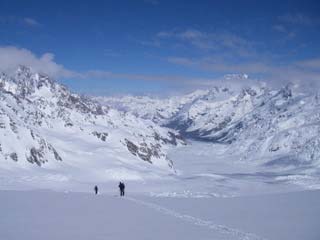
Bang! The engine roared and the nose descended. Again, Bang! And simultaneously, “Shriek!” from Sonia. In the back, Trev and I gripped our seats, white knuckled. Fortunately the pilot had warned us about the need to establish a “horizon” on the blank glacier snow, but we weren’t prepared for the violence of that first fly past, lulled during the 20 min flight from Mt Cook village by the magnificence of the scenery. The Cessna rose and quickly banked in to the final approach. Concerns for our own safety quickly turned to that of another ski touring party crossing directly in the line of our rapid approach at the base of the landing site - further convenient “contrast”. As we passed directly overhead we could clearly see the whites of their eyes.. The actual landing was smooth, and we quickly disembarked, unloaded the gear, and with a short roar and snow flurry the plane was gone. Only then did we really begin to appreciate the ski touring heaven we’d been dropped in to. We (Sonia Waters, Blair Leslie (both NZAC Wellington section), and Trev Breen (Otago section)) had arrived at Tasman Saddle in the Mt Cook National Park for five days of ski touring in the second week of September. Fresh snow, inches deep, squealed like dry sand beneath our boots. We stood on a wide gently rolling plateau, with the Tasman glacier descending in roughly two converging snow fields, encompassing Tasman Saddle hut about half a kilometre distant to the South, sitting prominently on a knife edge ridge at 2300 metres. Hochstetter Dome and the Aylmer ridge rose to 2800m to the North; the Main divide from Mt Elie de Beaumont to Mt Cook and beyond ran from the Nor’ to Sou’ West; the huge buttresses of the Malte Brun range towered directly to the South; and to the West, Kelman hut sat like a coin in the knuckle of Mt Abel, above the Tasman Saddle itself, with the Liebig and Two Thumb ranges stretching to the horizon beyond. With clear skies, wicked snow, magnificent terrain and breathtaking scenery – it was ski mountaineer’s catnip. We quickly gathered our “light” 18 kg packs and skied across the gentle slope to the door of Tasman Saddle hut - our home for the next three nights. We were greeted by our erstwhile “contrast” fellow skiers, a party of 8 out on a day trip from Kelman hut. We exchanged the story of our landing with equally humorous and exhilarating, but clearly different points of view, before heading out to spend the rest of the afternoon skinning back past the landing zone for a magic ski descent from the lower reaches of the Aylmer-Hochstetter south face. The next day, attempting to justify our slow start by the thought that we wouldn’t want to succumb to any non-existent spring ice, we left the hut at a “responsible” time - 10 am to be precise. The party of 8 from the previous day had carved a skinning track up to the western shoulder of our objective, the Hochstetter Dome. Their tracks provided some peace of mind, as although the avalanche danger in the Mt Cook region had reduced to ‘moderate’ over the previous few days, slopes lee to the Nor’ West were reported to have some potential remaining instability. However, other dangers lurked. A massive serac had crumbled off the ice fall immediately beneath the Dome the previous day, carving a prominent fan across the schrund. But such concerns were soon behind us, with the dry powder providing perfect skinning conditions, and we were soon on the shoulder, with Mt Elie de Beaumont seeming close enough to touch across the Ledenfeld saddle. We were bathed in sunshine, while West Coast clag filled everything to the Nor’ West. Turning East to the Summit ridge an ice layer 10 cm down slowed progress on the steeper crux, with some loss of grip making skinning hard work. But we soon gained the summit. With lunch on top we enjoyed more magnificent views, this time straight down the Tasman to its confluence with the Rudolph glacier. Ascending the Hochstetter Dome, with Tasman glacier and Mt Cook (right) beyond The ski down brought huge smiles and whoops from us all, with 15-20cm of virgin powder and nothing even remotely close to catching our telemark edges. With a few hours of daylight still ahead we made for Kelman – the so called “cold hut” across the nèvè. The other ski party saw us coming, and brews and more stories were welcome. From Kelman we got our first view of the impressive and somewhat infamous Murchison headwall dropping steeply below, before a gentle ski and skin back to what we had rapidly come to regard as “our” hut. That evening, with the rays of the setting sun filtering in to the old pioneering hut, even the freeze dried meals tasted particularly good.