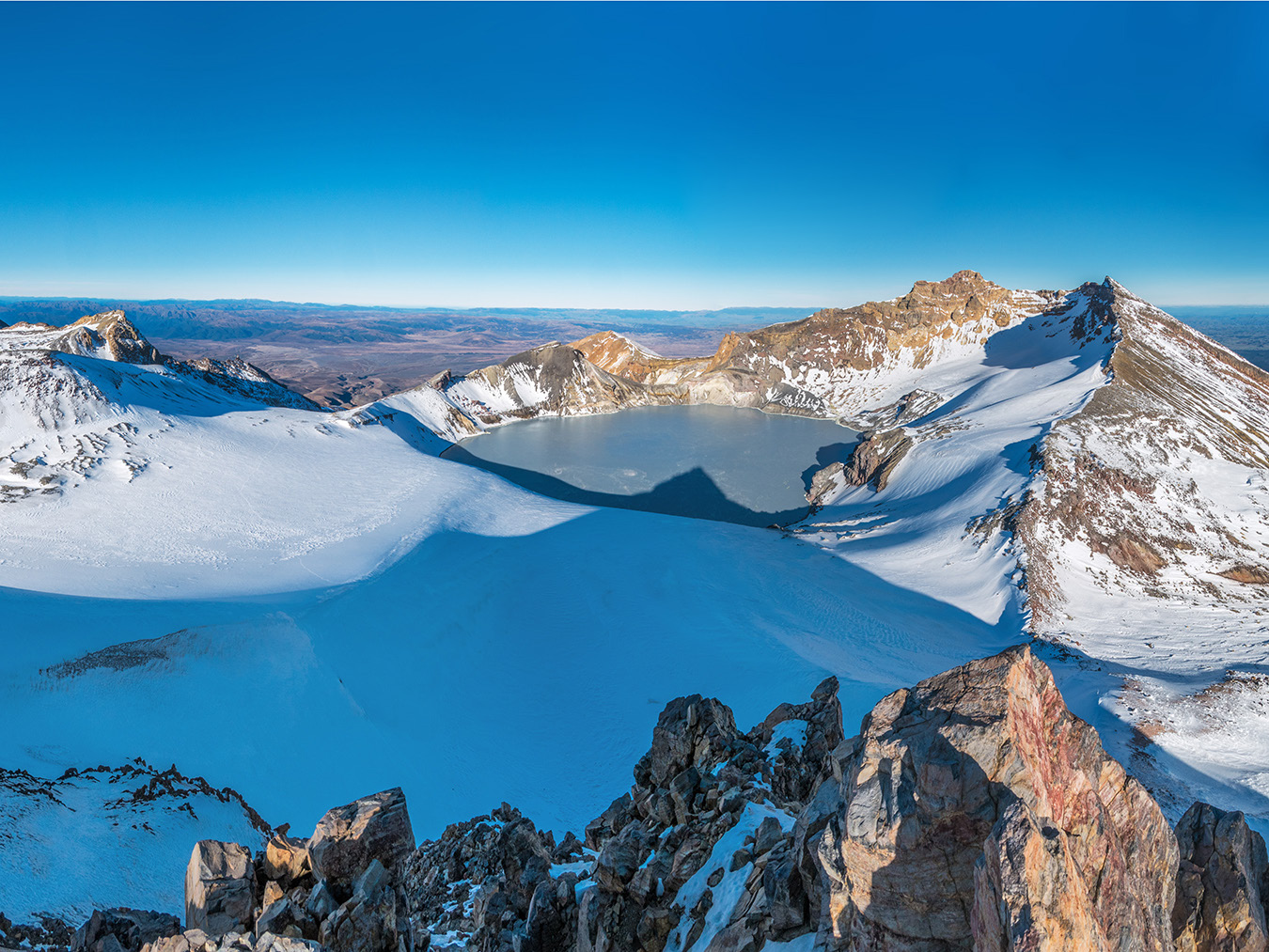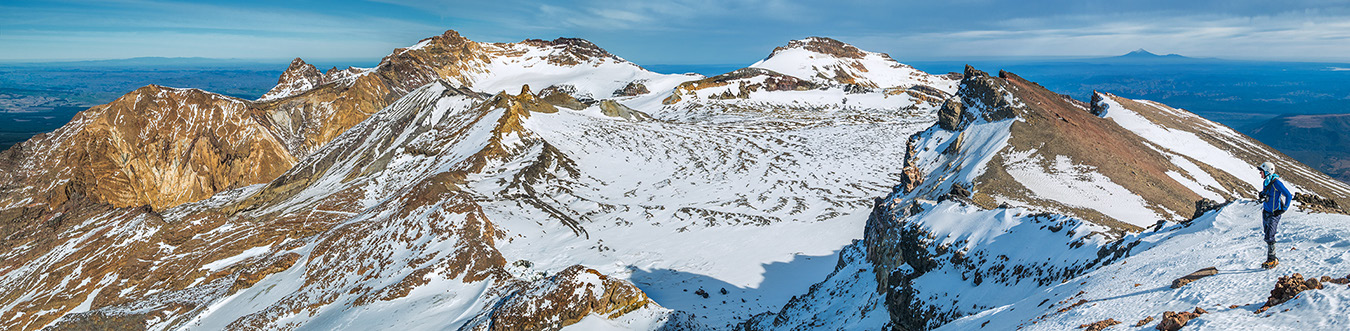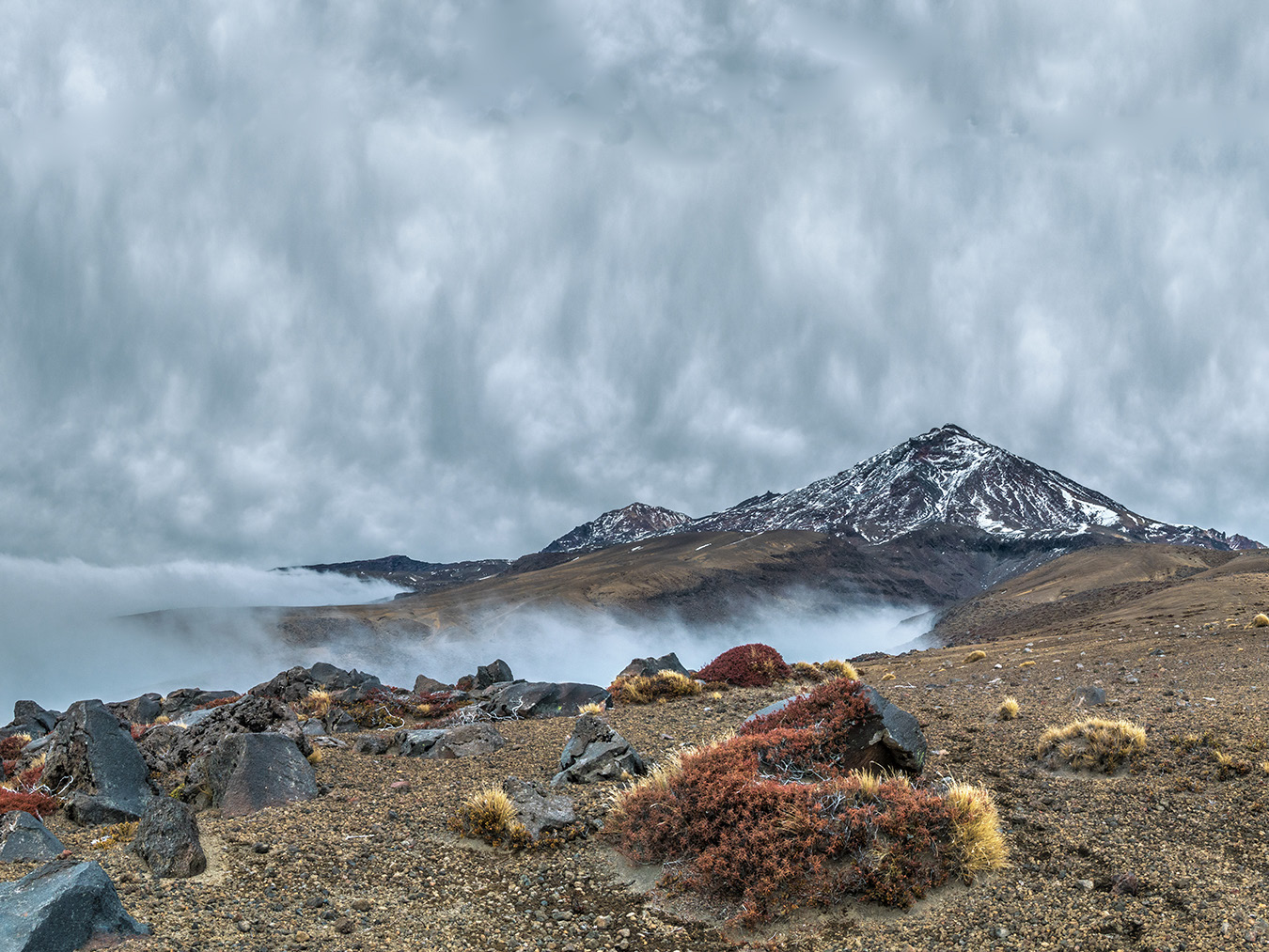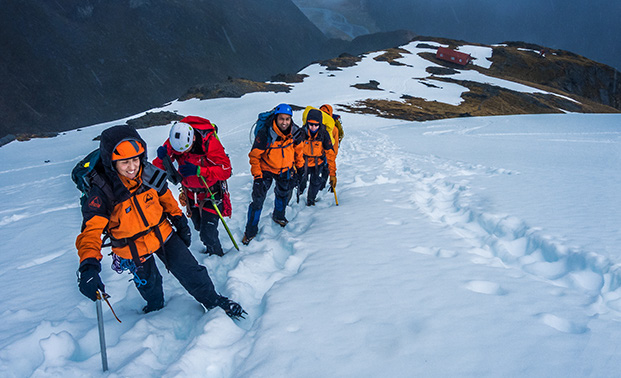
Words and pictures Peter Laurenson This image, looking south from Paretetaitonga was considerably more tenuous – a lot of very loose scoria and rubble, interspersed with patches of hard ice, mixed with plenty of exposure. At the first highpoint on the east side of the lake I lowered my tail and retraced my steps. As a consolation I plugged up to the steep, iced-up crags that started about 30 metres beneath the summit of Paretetaitonga, from which I enjoyed a panorama of the entire summit plateau, plus Ngauruhoe to the north-east. With tripods ready, as Shaun and I enjoyed an unfolding dusk a tiny figure appeared on the snow east of the Dome. ‘No way! I hope he’s got a tent with him.’ I said to Shaun, imagining the uncomfortable night ahead of us in our little tent if he didn’t. ‘At least he’s still alive.’ Thankfully, Jamie did have a tent. He also had a Spiderman costume which, while shivering, he climbed in to so we could take photos of him for his young son back home. It was the first time either of us had spent any time with a comic-book super hero on a mountain top, and I’ve got to confess, it was a very cool photo op (see the May Vertigo). Next morning, once packed up, we bid farewell to Spiderman, encouraging him to join a New Zealand Alpine Club snowcraft course as soon as possible. He clearly had drive and strength. And no doubt good balance too, considering the terrain he’d covered in his inadequate climbing gear. ‘If you can learn some mountaineering skills before you get into a tight spot, you’ll be much more likely to climb more mountains’ I reasoned. About an hour later Shaun and I began climbing up the northern crater rim towards Tukino Peak. While I’d been up Te Heuheu several times before, I’d only visited Tukino once, in July 2018. Then Tukino was a mass of rime ice, jutting out into a cavernous void. This time there was just volcanic rock, but the vertigo-inducing void remained. Shaun was suitably impressed. After slogging up through Tukino Village, where we paused to admire Don French’s new pièce de résistance at TASC Lodge – a beautiful new double glazed feature window at the western end of his lodge, we traced the poled route, in the direction of Whangehu Hut. It wasn’t long before hard, frozen snow encouraged out our crampons. As keen photographers, it wasn’t lost on us as we crested the ridge above the hut just as the magic began. Lovely light and colour, secluded tranquillity, but cold, and no stove to warm things up inside the hut. Nevertheless, it was great to there with the hut all to our selves. Our bubble burst about three hours after dark, when a young man appeared in shorts, soft trail shoes with strap-on four-point mini spikes and a 35 kg pack. Jamie from Hawke’s Bay was tough alright, but ill-prepared for the conditions he’d encountered. Next morning before setting off, we cautioned Jamie to be extremely careful if he chose also to ascend; pointing out that climbing down is usually harder than going up, so if in doubt, turn back. He was soon forgotten as we became immersed in our own climbing up the craggy ridge towards Cathedral Rocks. It was a beautiful morning and stretches of the frozen snow provided the perfect surface for our crampons. In other places it was very hard, requiring care and concentration, as we alternated between white stuff and volcanic rock. The summit plateau looked stunning in the bright sunlight. Certainly alpine, but not yet fully snow-coated, with patches of rich volcanic yellow, orange and crimson rock placing us in photographic nirvana. By midday we were setting up camp on top of the 2,672 metre Dome. While getting organised, it was so calm that we could leave our gear scattered about as we pleased. And there aren’t many ‘rooms’ in the North Island with a better view than our tent on the Dome. After lunch Shaun felt like some downtime, but I was keen to use the conditions to do a little packless exploring. My plan was to circumnavigate Crater Lake, as I’d done alone once before in winter conditions. It soon became apparent though, that in the thinner autumn conditions, the route This image, looking south from Te Heuheu Though Te Heuheu is slightly higher than Tukino, its summit is much friendlier. We enjoyed some time up there in calm conditions, taking photos and marvelling at the views. By now though, cirrus tendrils had appeared, reaching across the sky from the north-west to announce a coming weather change. It was time to continue. Our intended route down Waihohonu ridge didn’t look particularly appetising - a world of craggy lines, punctuated by bluffs. It’s ok when you can see the bluffs, but often they’re hidden from above and 20-metre topo lines can easily hide them too. Shaun led off, picking an exemplary route down the broken ridge. At 2,000 metres we arrived on a broad section of ridge with a great spot to pitch a tent. To our right was a big sloping slab of frozen snow, providing all the water we could need, and the view north to Ngauruhoe was superb. Though having been on the move for less than five hours, we called time anyway. By now the sky above was white with high cloud and there was plenty of interesting action going on nearer to earth to the west. The forecast was bearing out, so better to have less distance to walk back to our parked car next morning. Our afternoon was leisurely. By early morning our light tent was getting a windy workout. Later, as we packed up camp, a gust pounced from nowhere, snatching away the tent bag, nearly doing the same to the partially collapsed tent itself. Shaun donned crampons, shouldered his pack and headed down into a stream gully to retrieve the bag. I took a snow-free route further down the ridge, eventually reuniting with him a hundred or so vertical metres lower down. With the weather change we now relished a new kind of photographic palette. Bleak, but still texturally magnificent, and when sunbeams breached the thickening cloud, drama unfolded. Once again, the terra