
November 2004
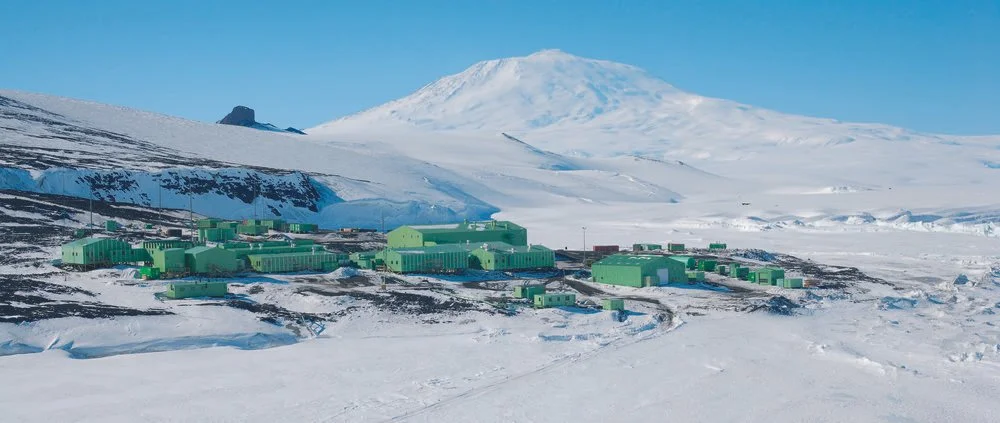
After one 7-hour returned flight, Pete finally reached Scott Base at minus 25 degrees. He began field training immediately, learning self-arrest techniques, snow shelter construction, and sea ice assessment. He trained on Hagglunds and PistenBully vehicles and started his meteorological duties, taking observations at 9am daily. The work involves measuring atmospheric chemicals and ozone levels using light frequency analysis and radio energy reflection techniques. Pete enjoyed cross-country skiing on sea ice during the extended daylight hours.
December 2004
The base hosted numerous science groups and distinguished visitors, including Sir Edmund Hillary, who came to commemorate the Air New Zealand tragedy on Mt Erebus. Pete flew by helicopter approximately 300 kilometres south to install an automatic weather station near Darwin Glacier. He was selected for the joint New Zealand-USA secondary Search and Rescue team from 160 applicants competing for 15 positions. Initial SAR training involved practicing crevasse victim extraction using bomb-proof anchors and hauling systems.
February 2005
Pete describes soreness from rigorous SAR training involving crevasse jumping and litter dragging across deep snow. The base celebrated Christmas and New Year appropriately, though a survey revealed only two people wanted Christmas songs played on the local radio station. A lost penguin was spotted near the base, prompting Pete’s humorous offer to teach GPS navigation, as magnetic compasses prove unreliable near the magnetic pole and volcanic Mt. Erebus. Graduate Certificate in Antarctic Studies students camped nearby, and one vehicle rolled during their fieldwork, though nobody sustained injuries.
March 2005
As the summer season ends, temperatures drop from approximately plus 3 degrees in January to minus 17 degrees. The winter crew expands from 11 to 19 people due to Hillary Field Centre construction projects. SAR training continues with scenario-based exercises simulating crevasse falls and hypothermia responses. The incoming winter crew received familiarization trips to the Imax crevasse, experiencing their first encounters with these formations.
April 2005
Pete reflects on environmental neutrality and the importance of proper adaptation during a SAR exercise in minus 25-degree conditions with wind chill. He describes wearing Scarpa plastic boots while managing ropes as a victim underwent rescue. Rather than complaining about harsh conditions, Pete focuses on efficient coping strategies: warming gloves inside his jacket, using his hood to trap exhaled breath, and maintaining positive attitude. He notes that viewing the orange-glowing mountains across McMurdo Sound restored perspective on the privilege of working in Antarctica.
May 2005
Ice climbing in nearby icefalls occupies Pete’s spare time with SAR team members. The Friday night darts tournament grew to include South Pole Station via HF radio and Italian personnel from Terranova Bay, creating an elaborate two-person hoax where two New Zealanders pretended to be three Italians competing remotely. The prank succeeded because people forgot that Mario Zuchelli Station had been closed for winter. Days grow increasingly short as temperatures hover around minus 25 degrees, with the coldest reading minus 37 degrees recorded so far.
June 2005
Pete led a three-attempt expedition to White Island (792 metres) across McMurdo Sound ice, approximately 50 kilometres south of Scott Base. The journey involved careful GPS-route following to avoid crevasses, with vehicles traveling roughly 40 minutes to reach their destination. The first group experienced fuel selector valve problems at minus 40 degrees, where rubber seals shrank and partially blocked fuel outlets. Pete’s successful group experienced warmer conditions at minus 30 degrees and witnessed an amazing sunset from the elevated summit before returning in complete darkness with a clear, starry sky.
July 2005
Pete explains “Polar T3 syndrome,” a condition affecting more than half of Antarctic winterers, caused by thyroid hormone depletion as muscles hoard these hormones to maintain body warmth. Symptoms include forgetfulness, depression, fatigue, and weight gain — research shows metabolism increases approximately 40 percent. The phenomenon explains why Pete forgot his article idea from the previous night despite remembering he’d conceived one. Management strategies include organisation, list-making, and regular schedules. Lack of sunlight exposure relates to vitamin D synthesis, though the body stores this fat-soluble hormone effectively from intermittent sun exposure.
August 2005
Extreme cold observations dominate this dispatch. At minus 40 degrees, vehicle gearbox oil becomes sluggish, requiring 20-minute warm-up periods. Electrical block heaters and extension cords maintain engine warmth at the hitching rail. The dry, low-humidity air causes intense static electricity buildup — Pete must regularly discharge by touching metal framework. At minus 48 degrees, boiling water thrown into the air freezes instantly, creating a powdery ice crystal shower. Pete notes that cold water doesn’t freeze using this method, raising intriguing physics questions about thermodynamics.
September 2005
Pete commands a realistic Search and Rescue training scenario in minus 30-degree temperatures with 20-knot winds creating dangerous windchill equivalent to minus 60 degrees. The fictional situation involved locating “Jill,” missing from the Castle Rock Loop hike. Pete coordinated hasty teams deploying rapidly in vehicles and organised a secondary response team with medical and rigging equipment. When “Jill” was discovered in a crevasse approximately ten metres down on a precarious snow bridge, Pete supervised a complex rescue involving T-slot anchors, a 9:1 pulley system, and the Arizona Vortex tripod. The rescue succeeded within 50 minutes. Lonnie, the Winter SAR Leader, commended the team’s smooth operation and professionalism.
October 2005
Pete witnesses the first sunrise in several months — astronomically occurring ten days earlier, but Scott Base’s southern-facing position meant waiting for higher sun angles. The “winfly” period brought four C-17 Globemaster flights from New Zealand, marking winter’s end and bringing fresh food, mail, and supplies. Pete experienced mixed emotions: happiness about receiving parcels, sadness about winter ending. The ice runway preparations required assessing sea ice thickness (five to six metres of old ice, versus expected one to two metres of new ice), complicated by inconsistent quality from previous summer’s melt pools. Scientists prepare for peak ozone destruction season in August-September, when polar stratospheric clouds display beautiful pink and blue mother-of-pearl colouration while chemical reactions occur on cloud surfaces.
November 2005
Pete reflects on completing his full year, feeling privileged experiencing all four seasons. Winter proved the most rewarding, and he emphasises that summer-only visitors miss crucial experiences. The replacement crew arrived, raising base population from 18 to 55. Pete completed his handover to the incoming science technician. His mixed feelings about departure include not missing the wastewater treatment plant’s smell and two-day weekends, but missing the camaraderie and competence of the winter team. Highlights included helicopter flights to Darwin Glacier (300 kilometres south) and training with the Joint Antarctic Search and Rescue Team, where he developed friendships with two fellow New Zealanders and ten Americans. Pete concludes with his standard joke about polar bear sightings: “Yes, there’s one behind every tree” — polar bears exist only in the Arctic.
I feel very privileged to have experienced the full four seasons here, but it has passed very quickly.